The Science Behind Microgreens
Years of nutritional research show why these tiny greens punch far above their size — concentrated vitamins, minerals, antioxidants, and phytochemicals studied for their role in a healthy diet. Here’s the evidence, explained simply.
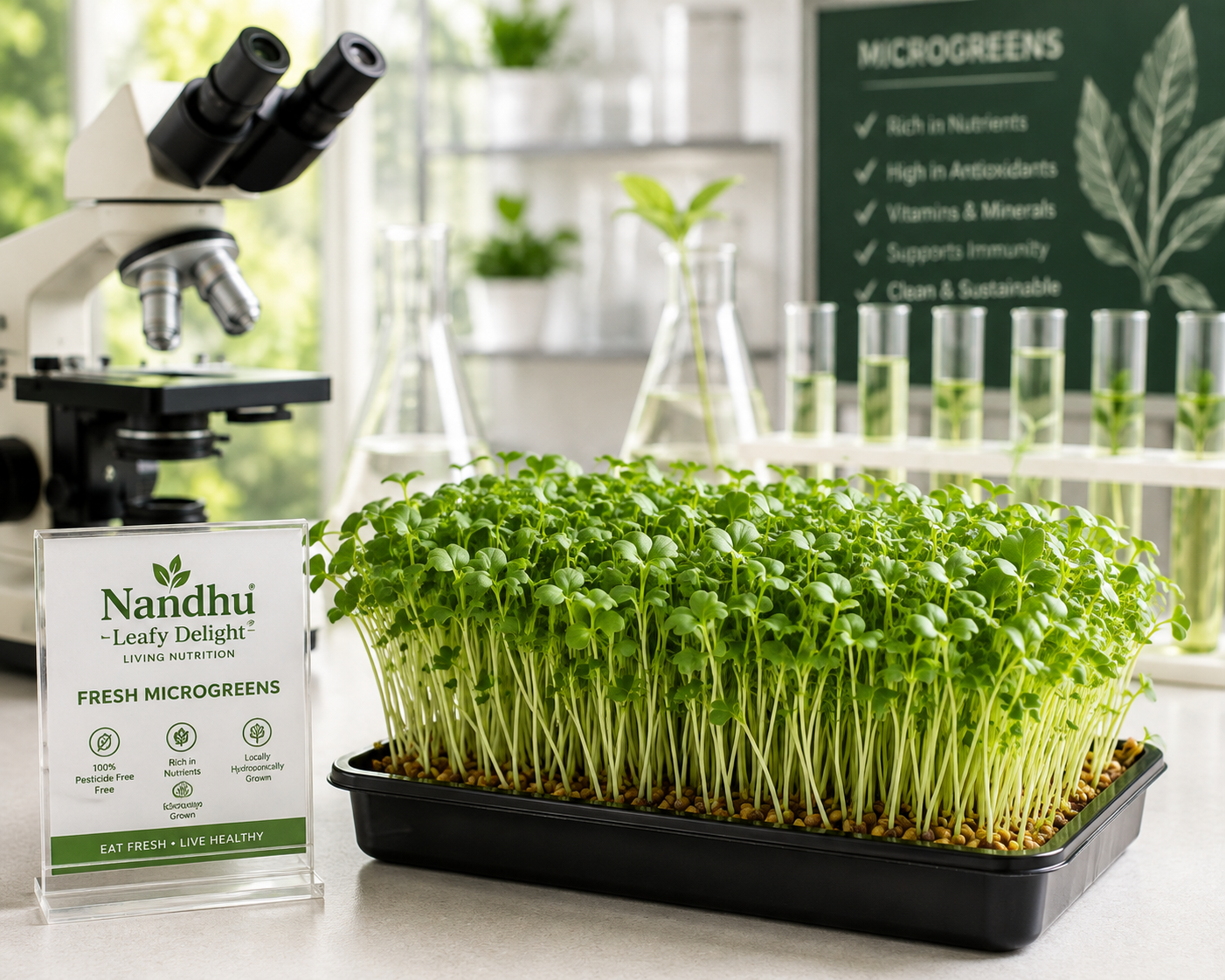
Fresh microgreens beside subtle science cues (a light microscope or lab glassware), bright and clean — evidence meets nature.
From the Lab to Your Table
Years of biomedical research have shown that plant-derived phytochemicals influence numerous biological pathways involved in maintaining health.
Rather than focusing solely on disease treatment, modern nutritional science increasingly emphasizes preventive nutrition — where foods rich in bioactive compounds help support normal physiological functions.
At Nandhu Leafy Delight, this scientific principle guides how we select and cultivate our microgreens. Each variety is chosen not only for its taste but for its naturally occurring phytochemicals, vitamins, minerals, and antioxidants — turning fresh microgreens into functional foods that complement a balanced diet and everyday wellness.
Broccoli Microgreens &
Sulforaphane
How a single bioactive compound activates your body’s master antioxidant switch — and why microgreens deliver it more potently than mature broccoli.
Sulforaphane is a naturally occurring organosulfur compound formed when glucoraphanin — found abundantly in broccoli — is hydrolysed by the enzyme myrosinase upon cell disruption (chewing or juicing). Broccoli microgreens contain significantly higher concentrations of glucoraphanin than mature broccoli, making them a superior dietary source.
Myrosinase enzyme converts glucoraphanin to bioactive sulforaphane upon cell disruption during chewing. Gut microbiota also contribute to this conversion.
Sulforaphane modifies cysteine residues on Keap1, releasing Nrf2 to translocate to the nucleus. Nrf2 then binds to Antioxidant Response Elements (ARE), upregulating cytoprotective genes including HO-1, NQO1, and glutathione-S-transferase.
Simultaneously, sulforaphane inhibits IκB kinase (IKK), preventing NF-κB from entering the nucleus. This blocks transcription of pro-inflammatory cytokines (TNF-α, IL-1β, IL-6, COX-2) — a dual anti-inflammatory mechanism.
The combined Nrf2 activation and NF-κB inhibition reduces oxidative stress markers, lowers systemic inflammation, and supports cellular detoxification — contributing to protection against chronic disease.
Nrf2 (Nuclear factor erythroid 2-related factor 2) is considered the cell’s primary defence regulator against oxidative stress. When activated by sulforaphane, Nrf2 orchestrates the expression of over 200 cytoprotective genes — far beyond what any single synthetic antioxidant can achieve.
NF-κB (Nuclear Factor kappa-light-chain-enhancer of activated B cells) is a central regulator of inflammatory gene expression. Chronic NF-κB activation is implicated in cancer, diabetes, cardiovascular disease, and neurodegenerative disorders. Sulforaphane inhibits this pathway at the IKK level.
Human clinical trials using broccoli sprout extracts — standardised for sulforaphane — have demonstrated measurable reductions in inflammatory biomarkers, improved antioxidant capacity (measured by FRAP and ORAC assays), and improved insulin sensitivity in participants with type 2 diabetes.
“Broccoli microgreens are not simply a smaller version of broccoli — they are a nutritionally concentrated functional food with a measurably higher sulforaphane precursor content. Their regular consumption may activate cellular defence mechanisms that mature vegetables cannot match at comparable serving sizes.”
This summary reflects findings from peer-reviewed literature. Individual responses to dietary sulforaphane may vary. This content is educational and does not constitute medical advice.
Fahey, J.W., Zhang, Y., & Talalay, P. (1997). Broccoli sprouts: An exceptionally rich source of inducers of enzymes that protect against chemical carcinogens. Proceedings of the National Academy of Sciences, 94(19), 10367–10372.
DOI: 10.1073/pnas.94.19.10367Mirmiran, P. et al. (2012). Broccoli sprout reduces oxidative stress in type 2 diabetes: A randomised double-blind clinical trial. European Journal of Clinical Nutrition, 66, 972–977. DOI: 10.1038/ejcn.2012.59
Houghton, C.A. (2019). Sulforaphane: Its “coming of age” as a clinically relevant nutraceutical in the prevention and treatment of chronic disease. Oxidative Medicine and Cellular Longevity. DOI: 10.1155/2019/2716870
Why Microgreens Are
Nature’s Superfoods
Microgreens are young vegetable greens harvested approximately 7–14 days after germination, at the cotyledon or first true-leaf stage. They are distinct from sprouts (which are germinated seeds eaten whole, root and all) and from baby greens (which are harvested later). At this early growth stage, microgreens concentrate the nutrients the plant has mobilised from the seed for rapid growth — resulting in a nutritionally dense food that research suggests may surpass the mature plant in several key compounds.
The term “superfood” is not a regulated scientific classification — it is a popular descriptor for foods with a high density of nutrients relative to their caloric content. By that definition, the research case for microgreens is strong: multiple peer-reviewed studies have documented significantly elevated levels of vitamins, minerals, and phytonutrients in microgreen tissue compared to their mature counterparts.
What distinguishes microgreens scientifically is not just their nutrient density — it is the form in which nutrients are present. Phytonutrients in young plant tissue are often more bioavailable, less oxidised, and accompanied by enzyme systems (such as myrosinase in the Brassica family) that activate their function upon consumption.
6 Reasons Research Supports
Microgreens as Functional Foods
Each of the following is grounded in published nutritional or clinical science, with key mechanisms briefly explained.
A 2012 USDA-funded study (Xiao et al., Journal of Agricultural and Food Chemistry) measured vitamins C, E, K, and carotenoids across 25 microgreen varieties. Results showed most varieties contained 4–40 times more nutrients by weight than their mature counterparts, with red cabbage microgreens delivering 6× more vitamin C and 69× more vitamin K than mature red cabbage.
DOI: 10.1021/jf300459bPolyphenols are plant compounds with established antioxidant activity. Research suggests that during the seedling stage, plants synthesise polyphenols at elevated rates as a response to UV light and oxidative stress — making microgreens a particularly concentrated source. Antioxidants neutralise free radicals implicated in cellular ageing and chronic disease pathogenesis.
Phenolic content · ORAC assayChronic low-grade inflammation is recognised as a contributing factor in arthritis, cardiovascular disease, type 2 diabetes, and certain cancers. Several microgreen varieties contain compounds — including glucosinolates (Brassica family), flavonoids (pea shoots), and betalains (beet) — that research suggests may modulate inflammatory pathways. This content reflects general research findings, not product-specific medical claims.
Research, not medical adviceThe dietary fibre in microgreens — though lower in absolute quantity than mature vegetables — is accompanied by prebiotic plant compounds and enzymes that may support the growth of beneficial gut bacteria. The gut microbiome is an active area of nutritional research, with links emerging between microbiome diversity and immune function, mood regulation, and metabolic health.
Prebiotic fibre · MicrobiomeVitamin K₁ (phylloquinone) is critical for carboxylation of clotting factors and matrix Gla protein, which inhibits arterial calcification. Microgreens — particularly from the Brassica and legume families — are among the richest dietary sources of vitamin K₁. Lutein and beta-carotene from red and orange microgreens are associated with reduced LDL oxidation in epidemiological studies.
Vitamin K₁ · Lutein · LDLUnlike dried supplements or processed foods, fresh microgreens retain active enzyme systems — including myrosinase (Brassica), amylase, and lipase — that enhance the bioactivation and absorption of their own phytonutrients. Myrosinase, for example, is responsible for converting glucosinolates into their bioactive isothiocyanate forms (including sulforaphane) at the moment of consumption.
Live enzymes · BioactivationScientific Cultivation Maximises What Research Identifies
The nutrient density advantages documented in research are not automatic — they depend heavily on cultivation conditions. Light spectrum, harvest timing, seed quality, temperature, humidity, and hygiene protocols all influence the final phytonutrient profile of the crop.
At Nandhu Leafy Delight Microgreens, our cultivation process is guided by the research literature on optimal growing conditions for functional phytonutrient expression — not simply by what produces the fastest or heaviest yield.
- Premium non-GMO seed selection — verified for germination purity and glucosinolate content where applicable
- Controlled indoor environment — temperature, humidity, and airflow regulated to minimise stress-induced nutrient loss
- Optimal light spectrum — full-spectrum LED at calibrated intensity to stimulate polyphenol and carotenoid synthesis without oxidative stress
- Harvest at cotyledon stage — when phytonutrient concentration is at documented peak before senescence begins
- Zero pesticide, zero herbicide — contaminant-free to ensure bioactive compounds are not inhibited or degraded
- Same-day harvest and pack — minimises post-harvest enzyme degradation and nutrient oxidation
- Research review process — cultivation parameters reviewed against published literature as new findings emerge
The Nutritional Case for Daily Microgreens
The convergence of nutritional density, phytonutrient bioactivity, enzyme preservation, and digestive compatibility makes microgreens a genuinely evidence-supported addition to a health-conscious diet. They are not a replacement for a varied diet — no single food is — but as a concentrated source of multiple functional plant compounds in a small, convenient serving, the research case is clear.
At Nandhu Leafy Delight, we grow microgreens not as a trend but as a response to the nutritional science — and we believe that transparency about what the evidence says and where its limits are is what distinguishes a credible food brand from a marketing exercise.
Ready to add science-backed nutrition to your daily diet?
Shop fresh microgreens
From Our Lab
to Your Reading
Sulforaphane & the Nrf2 Pathway: Why Broccoli Microgreens Are More Than a Trend
A deep dive into how sulforaphane — at concentrations 10–100× higher in microgreens than in mature broccoli — activates the Nrf2 transcription factor and simultaneously suppresses NF-κB, creating a dual anti-inflammatory effect that has been the subject of over 2,000 peer-reviewed studies since its identification at Johns Hopkins in 1992.
Vitamin K in Microgreens: What the USDA Data Actually Shows
The 2012 USDA-funded study by Xiao et al. remains the most comprehensive nutritional analysis of microgreens to date. We break down the methodology, what it found, and what it means for your plate.
Betalains in Beet Microgreens: Colour as a Functional Marker
The vivid red of beet microgreens is not just visual appeal — it signals the presence of betalains, nitrogen-containing pigments with documented antioxidant and anti-inflammatory properties. Here’s what the research says.
Harvest Timing & Nutrient Peaks: When to Cut for Maximum Value
Phytonutrient concentration in microgreens is not static — it peaks at a specific growth stage and declines as the plant matures. We explain the science of cotyledon-stage harvesting and why our timing decisions are research-driven.
Fenugreek Microgreens & Blood Sugar Regulation: The Saponin Mechanism
How fenugreek’s saponins and 4-hydroxyisoleucine may influence insulin sensitivity — and what the clinical trial evidence says about regular fenugreek consumption for individuals managing type 2 diabetes.
Red Cabbage Microgreens: Glucosinolates, Anthocyanins & Gut Health
Red cabbage microgreens contain both glucosinolates (same family as broccoli) and anthocyanins — the pigments responsible for their purple colour and studied for their role in gut microbiome modulation and colonic health.
Wheatgrass: Separating Evidence from Enthusiasm
Wheatgrass enjoys a large popular following — but what does peer-reviewed research actually support? We assess the chlorophyll content, enzyme activity, and clinical evidence for wheatgrass without the marketing overlay.
Get new articles in your inbox
We publish one research article per month — no marketing, just science. Unsubscribe any time.
Workshops &
Symposiums
We believe scientific knowledge should travel beyond journals. Our workshops and symposiums bring microgreen nutrition science to practitioners, educators, and curious minds across Tamil Nadu.
A half-day hands-on workshop covering the nutritional science of microgreens, cultivation methodology, and home-growing fundamentals. Guided by Dr. Balasankar and Dr. Ananthi. Suitable for health professionals, home growers, and students.
A full-day academic symposium on functional foods and phytonutrition, featuring invited researchers, a panel discussion on microgreens in clinical nutrition, and presentations from the CBT team. Open to registered dietitians, healthcare professionals, and postgraduate students.
A monthly 90-minute online session where our research team discusses a new peer-reviewed paper on microgreens, functional foods, or phytonutrition. Open questions welcome. Recordings available to registered participants. Free to join.
Hosting a nutrition or health event? We’d like to contribute.
Clinbiocare Technology and Nandhu Leafy Delight Microgreens are open to collaborating with hospitals, medical colleges, nutrition departments, and wellness organisations on research presentations, educational sessions, and product-demonstration events across Tamil Nadu and beyond. Our founders are available as invited speakers on microgreen nutrition, phytonutrition science, and functional food development.
Scientific knowledge that stays inside a laboratory or a journal is only half-useful. Our goal is to make the evidence for microgreen nutrition accessible — to practitioners who can apply it and to individuals who can act on it.
Knowledge is only useful
when it reaches your table
Everything on this page — the mechanisms, the studies, the cultivation principles — exists to explain why we grow the way we grow. The next step is yours. Whether you want to speak to our scientists, start a subscription, or simply ask which variety suits your health goals, we’re a WhatsApp message away.
All content on this Research page is published for general educational and informational purposes only. It is not intended to constitute, and must not be read as constituting, medical advice, a clinical diagnosis, a treatment recommendation, or a therapeutic claim about any product sold by Nandhu Organics LLP.
Nandhu Leafy Delight Microgreens products are foods, not medicines. We do not claim that our products prevent, treat, manage, or cure any medical condition, including but not limited to cancer, diabetes, cardiovascular disease, arthritis, or any other condition mentioned in the research summaries on this page.
Where peer-reviewed studies are referenced or summarised, the original authors and publications are credited and DOI links are provided. Summaries are our interpretation of published findings and may not represent the full scope, limitations, or conclusions of the cited work. Readers are encouraged to consult the original publications.
Nutritional science describes population-level findings. Individual responses to dietary changes vary based on genetics, existing health status, medications, and other factors. The nutrient concentration data cited (e.g. Xiao et al., 2012) reflects laboratory measurements under specific conditions and may not replicate exactly in all growing contexts or for all individuals.
This page is published in compliance with the Food Safety and Standards (Advertising and Claims) Regulations, 2018 (India) and related FSSAI guidelines. We are FSSAI licensed (Lic. No. 12426026000109). If you believe any content on this page constitutes a non-compliant health claim, please contact us directly at nandhuorganics@gmail.com.
If you have a diagnosed medical condition, are pregnant, breastfeeding, or are on prescribed medication, please consult a qualified healthcare professional — a registered physician or registered dietitian — before making significant dietary changes. The content on this page is not a substitute for professional medical or nutritional guidance.